
Experiential Measurement Framework: From Signals to Strategy
A practical framework for measuring experiential marketing using emotional signals. Move from counting activity to understanding impact.
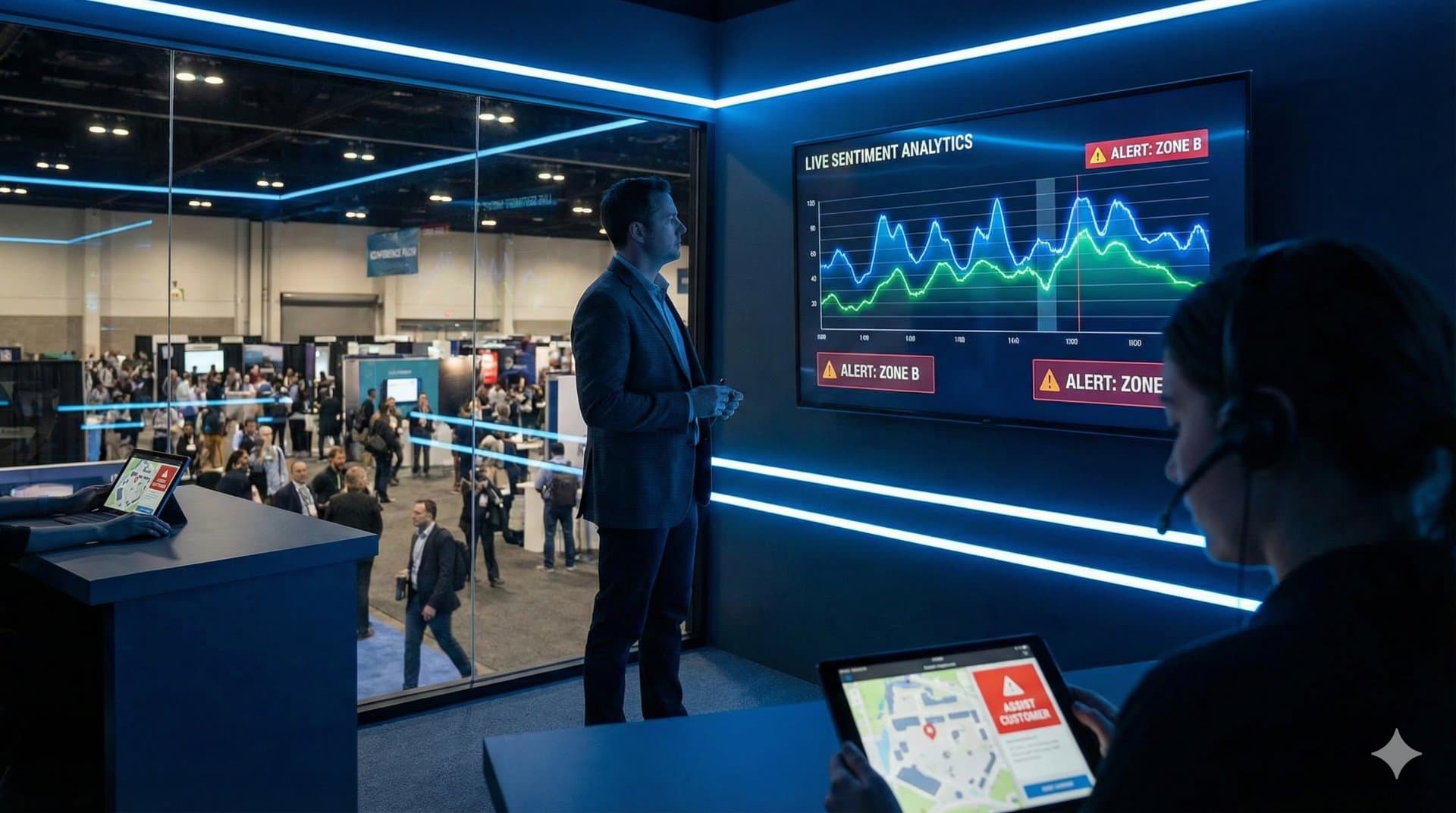
Experiential Measurement Framework: From Signals to Strategy
Most experiential teams measure what is easy to count. Attendance. Scans. Dwell time. Social mentions.
These metrics exist because they are available, not because they are useful.
A measurement framework built for experiential marketing should answer different questions: Did this experience resonate? Did it drive intent? Can we explain and defend the result?
This article outlines a practical framework for experiential measurement, grounded in emotional signals rather than activity counts.
Why Experiential Needs Its Own Framework
Experiential marketing is not digital advertising. It does not produce clicks, impressions, or conversion paths. Borrowing measurement models from digital channels forces experiential into a framework that was never designed for it, and guarantees it will underperform on metrics it was never meant to optimize.
Experiential creates behavior. The framework should be designed to measure it.
This is the premise behind Behavior Intelligence for experiential marketing: a measurement layer that captures emotional signals and translates them into insight that teams can review, compare, and trust.
The Four Layers of Experiential Measurement
Layer 1: Activity
What happened?
This is where most teams stop. Activity metrics include:
- Attendance and foot traffic
- Number of interactions
- Session duration
- QR scans or check-ins
Activity data is necessary but insufficient. It describes the volume of engagement without explaining its quality.
Layer 2: Response
How did people respond?
Response metrics interpret the quality of interaction:
- Behavior intensity (attention, relevance, motivation)
- Engagement depth vs. surface participation
- Choice patterns that indicate personal connection
- Participation quality across experience moments
This layer requires experience-native signal capture, interpreting interaction patterns, engagement depth, and choice behavior as behavior dimensions.
Layer 3: Insight
What does it mean?
Insight translates response data into explanations:
- Which moments drove the strongest behavioral response?
- What emotional drivers influenced behavior?
- How did this experience compare to previous ones?
- Where should investment be focused next?
Insight is what makes measurement actionable. Without it, data is just numbers.
Layer 4: Impact
Can we prove it?
Impact connects emotional insight to business outcomes:
- Engagement quality and its correlation with intent
- Behavior patterns mapped to downstream behavior
- Attribution confidence based on emotional signals
- ROI framing that finance and procurement teams can trust
Applying the Framework
Before the activation
- Define what success looks like, Not in attendance terms, but in response terms. What behavior do you want to create?
- Identify measurement moments, Map the experience journey and identify where emotional signals will be captured
- Set baselines, If you have prior activation data, establish comparison benchmarks
During the activation
- Capture experience-native signals, Interaction patterns, engagement depth, choice behavior, participation quality
- Monitor response in real time, Identify which moments are driving the strongest emotional signals
After the activation
- Interpret signals as insight, Move beyond counts to understanding
- Connect to outcomes, Map emotional signals to downstream behavior where identity bridges exist
- Compare and compound, Add this activation to your measurement library for cross-experience comparison
The Framework in Practice
| Layer | Question | Metric Type | Example |
|---|---|---|---|
| Activity | What happened? | Counts | 5,000 participants |
| Response | How did they respond? | Emotional signals | High attention + motivation in moments 3 and 7 |
| Insight | What does it mean? | Interpretation | Gamified moments drove 2.8x more intent signals than passive displays |
| Impact | Can we prove it? | Business connection | High-response participants showed 40% higher post-experience engagement |
What This Replaces
This framework does not replace existing data collection. It adds an interpretation layer that turns activity data into insight.
Teams that adopt this framework stop reporting what happened and start explaining what it meant. The conversation shifts from justification to strategy.
Building Measurement Maturity Over Time
The framework compounds. Each measured activation adds data, sharpens benchmarks, and increases confidence. Over three to five activations, teams develop:
- Cross-experience comparison capability
- Predictive insight about which experience formats drive the strongest response
- Defensible methodology that withstands procurement scrutiny
- A shared measurement language across creative, brand, and finance teams
In the RBC x Music augmented reality experience, this framework was applied to capture emotional signals during gameplay and connect them to intent and engagement, transforming a one-off festival activation into a measurable, repeatable insight source. Read the full case study.
Start Where You Are
You do not need to implement all four layers at once. Start with Layer 2, capturing behavior signals, and build upward. The most important step is moving beyond activity counts.
See how other teams are building measurement maturity on our Proof page.
Behavior Intelligence is Ether's approach to measuring emotional impact in experiential marketing. Learn more about Behavior Intelligence for experiential marketing.
Related Articles
![Featured image for Do Your Events Actually Work [Podcast With Justin O'Heir]](/_next/image?url=https%3A%2F%2Fbanmfdzjkzlkhakecmfm.supabase.co%2Fstorage%2Fv1%2Fobject%2Fpublic%2Fcontent%2Farticles%2FEther_do-your-events-actually-work-podcast-with-justin-o_2026-07-24_16-21-58.jpg&w=2048&q=75)
Do Your Events Actually Work [Podcast With Justin O'Heir]
Founder of Ether hopped on with The Connector's Table Podcast to chat about how Ether measures offline experiences.
 Justin O'Heir
The 5 KPIs Every Experiential Agency Should Be Reporting (That Most Aren't)
Most experiential agencies report on foot traffic and impressions. The agencies that keep their clients report on these 5 KPIs instead, and they're the ones that survive budget reviews.
 Miriam Arbus
How Agencies Prove Experiential ROI to Clients Without Relying on Foot Traffic
Foot traffic and impressions don't prove experiential ROI. Learn how leading agencies use Behavior Intelligence to deliver defensible activation measurement that keeps clients investing.
Justin O'HeirInterested in implementing this for your brand?